Bounded Agency: Containing Probabilistic Software Across Six Production Systems
How two-tier containment—fast probabilistic pre-gates paired with deterministic OS, visual, market, and database invariants—tames high-velocity AI generation across six live production systems.
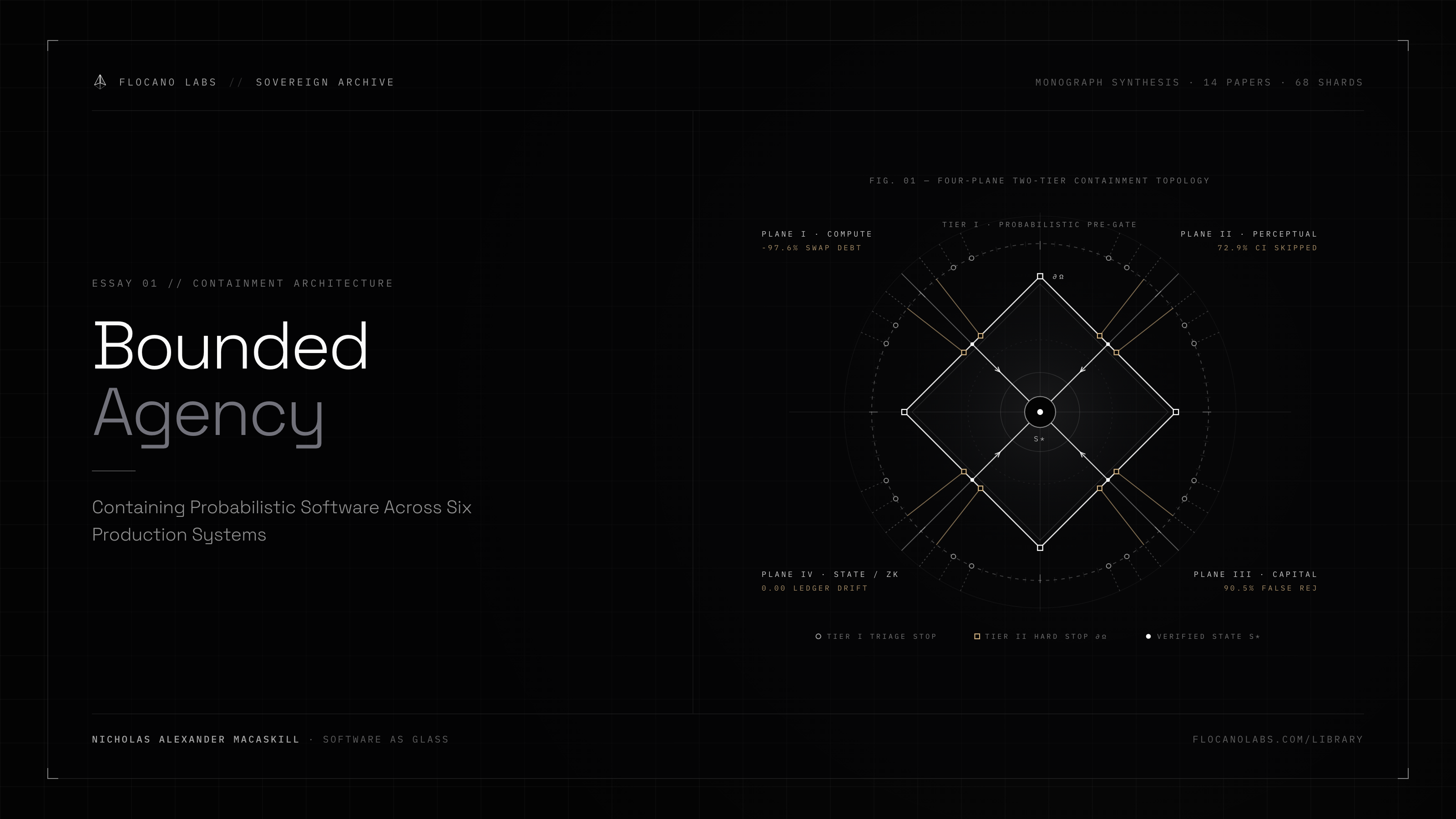
Look at the final nouns of the engineering monographs we published this year at Flocano Labs:
Harness. Gating. Bounds. Calibration. Crucible. Governor. Protocol. Rail. Isolation.
Almost none of those papers describe how to generate more output. Every one of them documents a containment boundary.
Across 14 flagship monographs and 68 modular shards spanning six live production systems—BayesianPivot, Bet Bodhi, East High Performance Centre, Verithra, Software as Glass Monorepo, and GlassMetric—the same bottleneck surfaced in every domain. Once probabilistic models and autonomous agents are turned loose against live state, generation stops being the scarce resource. Bounded agency becomes the actual engineering problem: placing cheap, verifiable boundaries directly in front of irreversible action.
1. Why Classic Defense-in-Depth Is No Longer Enough
A veteran systems engineer can rightly object that fail-closed design, database constraints, and defense-in-depth have existed since the 1970s. What actually changed?
Classic safety engineering assumed slow, expensive human authoring. When a team wrote a few hundred lines of production code a week, human code review, static checklists, and hand-crafted integration fixtures could plausibly keep pace with mutation volume.
Foundation models and coding agents broke that ratio. Marginal generation cost is approaching zero, which multiplies the volume of plausible-looking candidate mutations—UI components, SQL migrations, statistical signals, executive deliverables—by an order of magnitude or more. Human attention does not scale alongside it. Left unbounded, high-velocity probabilistic generation produces silent entropy:
- Interfaces and client PDFs that compile cleanly and pass HTTP 200 checks while clipping mobile viewports, burying navigation controls, leaking staging artifacts, or breaking silently across native PDF renderers.
- Background agent swarms that exhaust local unified memory into SSD swap thrashing and destabilize an operator's workstation.
- Quantitative models that pass naive backtests while failing under small-sample estimator distortion, phase-lagged regime filters, or unmodeled tail drawdowns.
- Serverless API routes that trust application-layer permission checks until concurrent load triggers double-booked inventory or cross-tenant reads.
When mutation throughput outstrips manual review, containment can no longer depend on human vigilance or synthetic unit fixtures. It has to be automated, adversarial, substrate-native, and self-ratcheting: every failure that escapes into production becomes a permanent machine-enforced boundary.
2. The Two-Tier Containment Stack
Early on, we made a conceptual mistake: we treated every verification check as if it belonged to the same class. In practice, a statistical commit predictor and a PostgreSQL row lock do completely different jobs. Conflating them leads to either bloated CI runtimes or false confidence.
Working systems separate containment into two distinct tiers based on verification cost and state irreversibility:
| Tier | Mechanism | Failure Profile | Where It Belongs |
|---|---|---|---|
| Tier 1: Probabilistic Pre-Gates | Commit-time defect predictors, isolated adversarial perceptual critics, permutation null gates | Fast and cheap, but non-zero false negatives | Upstream triage: cutting verification search space and rejecting obvious drift before expensive suites or human review run |
| Tier 2: Deterministic Invariants | Darwin Mach taskpolicy QoS, PostgreSQL RLS & row locks, bounding-box occlusion assertions, zero-box-shadow print guards, Noir UltraPlonk proofs |
Zero-trust, reproducible hard stops | Directly in front of irreversible state: live capital, PII, multi-tenant rows, OS memory stability, and external client deliverables |
Tier 1 buys speed; Tier 2 guarantees safety. An upstream statistical gate that skips most browser CI runs while catching the majority of regressions is valuable precisely because it narrows the funnel cheaply—never because it is infallible. Some regressions will always bypass a probabilistic filter, which is why Tier 1 gates never stand alone in front of irreversible mutations. They feed directly into Tier 2 invariants that cannot be talked out of failing.
3. Plane I — Compute & Operator Containment
Containment starts on bare metal before application logic runs. When multiple local coding agents, browser test harnesses, and MLX inference loops compete with a human operator on the same Apple Silicon workstation, default OS scheduling degrades both.
On our primary workstation, concurrent agent swarms pushed SSD swap debt to 5,861 MB, introducing visible 120Hz frame drops and jitter across background execution processes. Rather than buying heavier cloud runners, we moved the boundary into Darwin itself. In Sovereign Agentic Runtime Governor and Deep Darwin Systems Architecture for Real-Time AI Agents, interfacing directly with Mach kernel taskpolicy QoS APIs to pin background agent workloads onto Efficiency cores—paired with explicit 1024 MB V8 heap bounds—cut SSD swap debt by 97.6% (down to 142 MB) and held the display locked at 120 FPS with zero bot scheduling jitter.
The same logic applies one layer above the kernel: the operator. In live trading infrastructure, one of the most common catastrophic failure modes is a fatigued human manually overriding an automated risk limit during drawdown. Through GlassMetric (Sovereign Somatic Telemetry & Bio-CPU Governance), local fleet telemetry is logged alongside operator state in a headless SQLite WAL daemon (<0.12ms local write latency, 38 MB RAM, zero cloud egress) so behavioral drift is measured on the same timeline as machine execution rather than excused after the fact.
4. Plane II — Code, Perceptual & Multi-Format Containment
This plane taught us our sharpest lesson about boundaries that fail silently while staying green.
What Broke First: Why Seven Static Agents Failed on Rendered Pixels
Our first brand and UI verification architecture (ACCO-P) modeled a seven-agent creative agency—splitting strategy, art direction, copy, layout, static anti-slop linting, web-ergonomics auditing, and Retina rendering across seven distinct roles. Static HTML and regex linters reliably blocked boilerplate SaaS copy, fixed 1440×900 poster locks, and shallow single-section templates.
Then we deployed AI-assisted layouts onto live commercial web pages and executive PDFs, and static linters missed every failure that actually mattered to human readers:
- Legacy staging PNGs embedded on a public page leaked internal account identifiers inside raster pixels while passing every DOM and HTTP check.
- Translucent CSS
box-shadowrules looked clean inside headless Chromiumpage.pdf(), then alpha-flattened into harsh grey rectangles inside Apple Preview and iOS Mail. - Standard Playwright responsiveness checks (
document.documentElement.scrollWidth <= window.innerWidth) stayed 100% green across 25 routes whileoverflow-hiddenmasked-20pxoff-screen link bleed, duplicate mobile navigation leaked ghost icons, floating corner orbs overlapped tap targets, and fixed bottom tabs buried page footers by 99px.
The Structural Consolidation
Adding more LLM personas did not fix the blind spot. Collapsing everything into a single self-grading agent would have made it worse.
In Adversarial Multi-Format Visual Harness (StepGate), we compressed the seven-persona org chart down to two decoupled LLM roles wrapped in deterministic measurement engines:
- Desktop & Brand Craft (Tier 1 Isolated Critic): One production builder works directly inside the live Next.js codebase; a separate 5-axis perceptual critic grades 2x DPI captures in a fresh context with zero authorship bias. On the live EAST Labs commercial showcase (
app.eastsportsgroup.com/labs), the critic rejected v1 at 6.86 / 10, surfaced six privacy, data-viz, and V8 trigonometric hydration defects, and drove a ground-up v2 rebuild approved at 9.14 / 10 (+2.28 lift, zero console/hydration errors). - Mobile Parity & Predictive Commit Gating (Tier 1 + Tier 2): Across 25 routes in the Software as Glass Monorepo across three hardware viewports (
375px/390px/1440px), we replacedscrollWidthchecks with per-element bounding-box bleed, fixed-chrome occlusion depth, and zero-CSP console assertions (75 / 75 passing). Upstream, we trained a sub-5ms Forward-SZZ Newton-GBDT mobile risk predictor across 640 historical UI commits (0.7447out-of-time AUC,p = 0.005across 200 permutation draws,3.09xtop-quintile lift), capturing 66.7% of out-of-time mobile regressions while skipping 72.9% of browser CI runs. Its single strongest causal signal wasresponsive_modifier_ratio—styled JSX/Tailwind markup edited without responsive breakpoint modifiers—allowing pre-push hooks to pinpoint the exact risky file and route before a browser launches. - Cross-Engine Print Proof (Tier 2 Deterministic): Pre-print static guards hard-fail on any CSS
box-shadowor lexical PII token, followed by native macOSObjC.import('PDFKit')2x DPI rasterization so executive PDFs are audited through Apple's exact Preview/iOS Mail engine rather than Chromium's self-preview.
On the general code plane, Closed-Loop Code Reliability Algorithm (Autopoietica) applies the same two-tier structure to backend and application commits: a 33ms Forward-SZZ blame model (89.2% out-of-time top-quintile precision on EAST across a 500-draw permutation null gate) flags risky diffs before push, while verified failures route into detached git worktrees under a mandatory RED -> GREEN differential proof gate and mutation tests (Tri-Axial Invariant Crucible, Human-Gated Agentic Invariant Protocol) so test suites cannot pass vacuously.
5. Plane III — Capital & Microstructure Containment
Live markets punish unverified assumptions faster than any compiler. Across BayesianPivot and Bet Bodhi, the biggest gains came from tightening what a model is forbidden to trade rather than hunting for noisier entry signals.
Two specific statistical failures forced hard boundaries:
- Small-Sample Estimator Distortion: Classical Rescaled Range Hurst estimation on intraday windows exhibits systematic Brownian bridge compression bias, making random walks look mean-reverting and misclassifying market regimes. In Finite-Sample Fractal Calibration, applying the Anis-Lloyd analytical correction across 26,352 continuous walk-forward 5-minute bars shifted calibration by
+0.121and unlocked+17.66Rrealized alpha (62.0% fleet win rate). Similarly, Epistemic Phase Transition Signatures replaced lagging GARCH/HMM regime filters with<0.20msApple Silicon MLX order-parameter tensors that rejected 90.5% of false regime transitions (0 / 100,000random permutation draws exceeded the gate,p < 0.00001). - Asymmetric Ruin & Zero-Capital Shadowing: Standard accuracy loss treats a missed entry and a tail-risk liquidation symmetrically. Across Session Opportunity Capacity Bounds (12,057 vetoed setups, 7,322R avoided loss) and Multimodal Kinematic Execution Gating, models are gated by asymmetric ruin penalties and a four-variant counterfactual shadow lab so live capital only touches regimes that have cleared empirical calibration out of sample.
6. Plane IV — State, Multi-Tenant & Cryptographic Containment
At the database and protocol layers, bounded agency means refusing to trust application-layer goodwill. When dozens of families book shared facility capacity concurrently or credit balances reconcile asynchronously from payment webhooks, a single missing if check in an API handler can double-spend a wallet or expose a minor's profile across roles.
In East High Performance Centre (Database-Level Zero-Trust Access Isolation), role isolation (sys-admin, coach, parent, player), capacity checks, and credit ledger mutations live inside PostgreSQL itself: Row-Level Security policies validate every query in <1.5ms with zero access failures, while pessimistic row locks and transactional SQL RPCs (High-Concurrency Booking & Schedule Locks, Asynchronous Stripe Transaction Reconciliation Ledger) enforce zero double-bookings (<12ms) and 0.00 balance drift across 1,657 booking transactions and 2,990 credit ledger mutations. Even a buggy client route cannot violate tenant or ledger invariants.
On external capital rails, Verithra (ZK Performance Attestation Circuit) and Autonomous Decentralized Settlement Rail extend the same principle cryptographically: client-side Noir UltraPlonk zero-knowledge circuits attest that a closed-trade series satisfies a public Sharpe threshold and commitment window without exposing individual entries, exits, sizing, or venue identifiers.
7. The Failure Modes of Containment Itself
Across all four planes, the core engineering principle reduces to one sentence:
You do not need a perfect generator if your containment boundaries reject bad states cheaply, deterministically, and before irreversible commitment.
Containment still has two failure modes of its own that require constant discipline:
- Boundary Ossification: Over-constraining a system until shipping speed dies. A verification gate exists to let probabilistic engines run at full speed in production without corrupting state—never to replace shipping with theatrical governance.
- Boundary Decay: Static guards age out quietly as browsers, rendering engines, models, and market regimes shift. A boundary that never gets tested against live production entropy eventually turns into the exact green-CI mirage it was built to replace.
Keep Tier 1 triage fast, put Tier 2 deterministic invariants directly in front of irreversible state, and convert every escaped defect into a permanent ratchet. Then let the verified systems run.
Containment is the first half of the architecture; read the companion signal thesis, Modeling Breakdown: Why Equilibrium Models Decay and Embodied Signals Endure, covering Phenomenological Deep Learning, Praxical Breakdown Architecture, and live biomechanical broadcast vision.
Appendix: Production Archive Reference
Explore the complete 14-monograph, 68-shard catalog—filterable by project (SELECT_PROJECT) or engineering discipline—at The Sovereign Archive.