Modeling Breakdown: Why Equilibrium Models Decay and Embodied Signals Endure
Companion to Bounded Agency: formalizing Husserlian protention decay, Heideggerian praxical breakdown, Merleau-Ponty somatic cliffs, and live 4-FPS broadcast vision across BayesianPivot, Bet Bodhi, and GlassMetric.
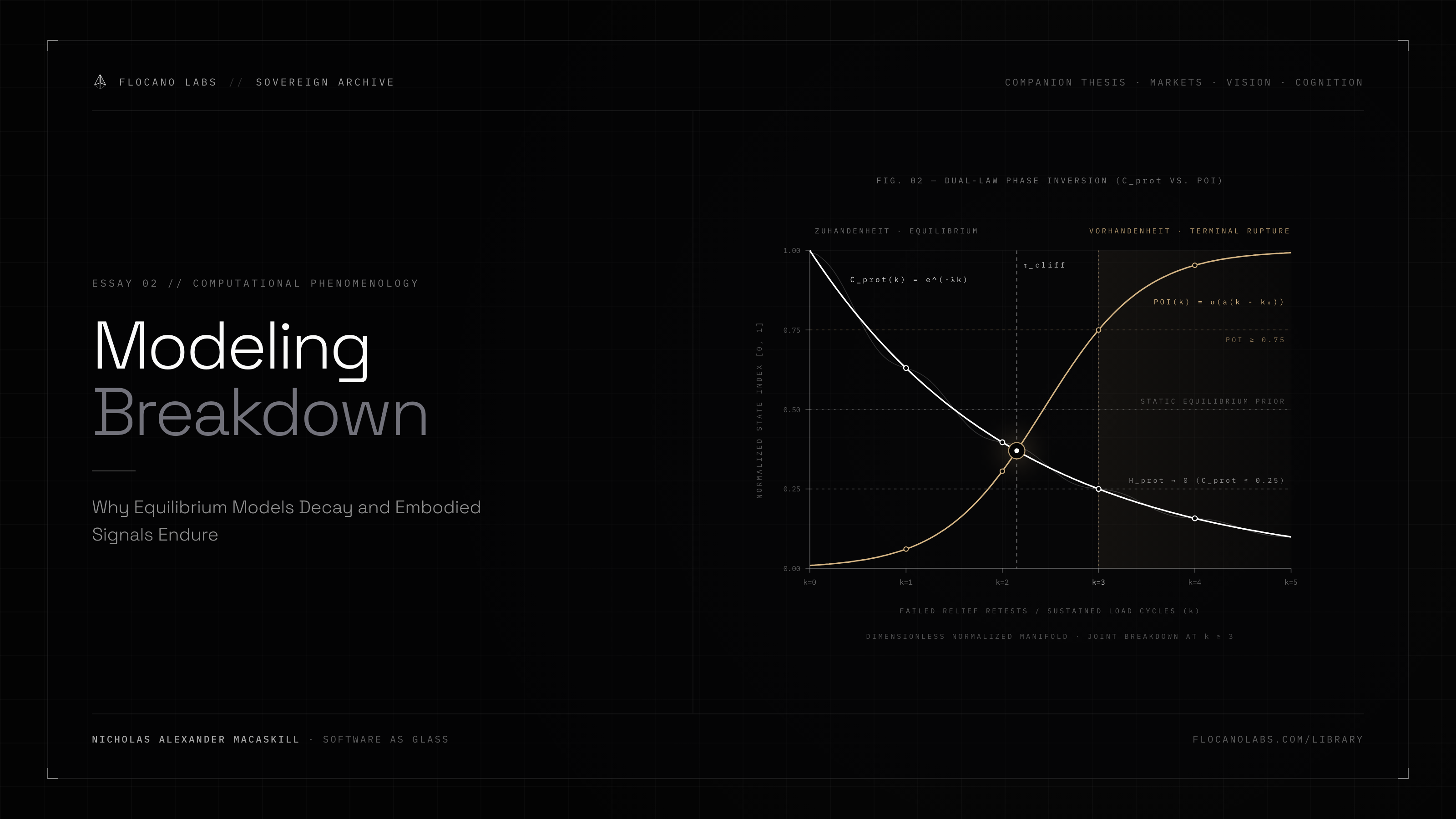
Most quantitative models die within 6 to 18 months of hitting live markets. The standard diagnosis blames overfitting, regime shifts, or crowding. Those are symptoms. The structural mistake sits deeper: treating human-contested arenas as closed third-person physics.
Conventional quant finance models price as an external particle drifting under Brownian motion and declares an asset "overextended" when a static formula crosses a threshold—RSI above 70, two-sigma Bollinger bands, arbitrary moving-average gaps. Traditional sports analytics makes the same assumption in another arena: Sabermetric lookup tables treat baseball as a stationary Markov chain of independent plate appearances and model pitch counts as smooth arithmetic counters.
Dead formulas cannot feel pain, fatigue, or decision paralysis. Price does not reverse because a moving average looks stretched, and an exhausted athlete does not degrade linearly from pitch 87 to pitch 88. Both move until the living human participants on the wrong side of the arena cross a biological or cognitive breaking point.
Feeding raw OHLCV candles or box scores directly into an LLM fails for the opposite reason: autoregressive transformers are semantic pattern engines, not numerical differential-equation solvers.
Across BayesianPivot, Bet Bodhi, and GlassMetric, we built a third path—Computational Phenomenology. We do not claim synthetic consciousness or "market empathy." We formalize four structural invariants of embodied human breakdown—drawn from Husserl, Heidegger, Merleau-Ponty, and Schütz—as deterministic state machines and multimodal pipelines operating directly on orderbooks, live broadcast video, and operator telemetry.
1. The Four Invariants of Embodied Breakdown
In adversarial arenas—continuous financial double auctions, live championship sports, and high-stakes operator consoles—participants never interact with sterile third-person statistics. They act from inside a finite nervous system under time pressure. Four repeatable dynamics recur across every system we studied:
| Structural Dimension | Phenomenological Mechanism | Computable Production Signal |
|---|---|---|
| Temporal Expectation Collapse | Husserlian Protention (Retention -> Primal Impression -> Protention) | Failed relief bounces against an entry anchor eroding a trapped cohort's forward recovery horizon (C_prot decay) |
| Praxical Rupture | Heideggerian Zuhandenheit -> Vorhandenheit | Smooth autopilot scripts (trend holding, bullpen rotation) snapping into acute cognitive friction and delayed reaction |
| Somatic Invalidation | Merleau-Ponty's Lived Body (Leib) | Non-linear physiological cliffs: anaerobic fatigue biomarkers in live video, biomechanical velocity/spin decay, sympathetic tunnel vision |
| Intersubjective Trust Failure | Schütz's Intersubjective Horizon | Disappearing orderbook bid depth and unabsorbed sell delta proving collective defense has evaporated |
Equilibrium models look backward at where averages used to sit. Embodied models track where the human substrate is actively failing right now.
2. Financial Auctions: The Pain Surface & the Anti-Suffocation Proof
In BayesianPivot (Phenomenological Deep Learning), we split execution across a strict dual-process boundary:
- System 1 (
<0.2msDeterministic Tape Engine): Measures objective microstructural strain—Equal High/Low liquidity shelves, time held underwater, volatility-normalized adverse excursion, failed relief retests, and Wyckoff volume-versus-displacement dissonance (high aggressive volume producing near-zero candle progress, exposing resting institutional absorption). - System 2 (Local Apple Silicon 4-bit MLX LoRA): Runs amortized inference over the resulting phenomenological state vector—classifying whether the trapped counterparty cohort is still in early Denial, Bargaining, Exhaustion, or Active Capitulation.
That architecture replaces static oscillator overextension with a human-grounded definition: a market is not overextended because price is far from an average; it is overextended only when the cohort trapped on the wrong side reaches biological and capital pain saturation.
To quantify saturation, System 1 computes a bounded tri-axial Pain Overextension Index (POI) combining three observables:
- Duration Underwater (The Capitulation Clock): Retail traders absorb floating loss on adrenaline for 10–15 minutes; sustained underwater pressure across 30–45 minutes without relief degrades cognitive stamina sharply.
- Adverse Excursion: Unrealized drawdown normalized by regime-adaptive volatility (
ATR). - Trapped Mass: Cumulative volume locked on the wrong side of the structural shelf relative to prevailing book depth.
Paired with exponentially decaying Protentive Coherence across each failed relief bounce, POI distinguishes an asset trending cleanly on low entrapment (do not fade) from a trend running out of forced-liquidation fuel.
Empirical Ablation: Why Naive Breakeven Stops Destroy Expectancy
The cleanest empirical test of counterparty phenomenology came from an ablation study across 209,670 five-minute candles covering full-year 2025 Bitcoin and Gold/PAXG:
| Execution Policy | Total Trades | Full TP Wins | Clipped at Breakeven | Net Return | Spread |
|---|---|---|---|---|---|
Naive Breakeven Trail (+1.0R) |
2,539 | 568 (22.4%) | 495 | -337.26 R | Baseline Loss |
Anti-Suffocation Hold (+1.4R) |
4,359 | 1,451 (33.3%) | 0 | +232.41 R | +569.67 R |
A textbook risk rule—trailing stops to breakeven at +1.0R—turned a profitable structural signal into a -337.26 R bleed, clipping 495 winning trades before they played out.
The failure was behavioral, not mathematical. Trapped cohorts rarely capitulate in a straight line; they average down and force one or two violent relief spikes back toward entry before margin liquidation hits. Tight breakeven stops get suffocated by the trapped herd's dying breath. Holding the initial stop wide past retail noise until capitulation becomes irreversible swung net expectancy by +569.67 R across the exact same underlying market data—and conditioning entries on mature accumulated shelves cut Gold max drawdown by 56.8% (to 22.27 R, profit factor 1.24).
3. In-Play Sports Microstructure: Managerial Paralysis Meets the Somatic Cliff
Decentralized prediction markets expose the exact same blind spot in a cleaner, bounded laboratory. In Bet Bodhi (Praxical Breakdown Architecture), we studied why automated market makers on Polymarket CLOB consistently misprice a specific late-inning baseball transition.
Standard RE24 and Markov win-expectancy tables price a home team trailing by 1 run in the 7th inning around 25%–30% (0.25–0.30 USDC per share). Those tables assume linear pitch degradation and instant, frictionless dugout optimization. Live games break both assumptions at once:
- Heideggerian Dugout Rupture: Through six innings, a visiting manager's bullpen script runs ready-to-hand—starter covers six, setup bridge covers the eighth, closer takes the ninth. In a 1-run 7th inning with the starter deep past physiological fatigue thresholds and the top of the order (batters 1–4) due up, the script shatters. Pulling the starter burns the bullpen early or exposes a lower-tier middle reliever; leaving him in gambles on stealing three more outs. Caught between two high-variance options, managers hesitate—converting smooth coping into delayed action.
- Merleau-Ponty Somatic Cliff: Past the anaerobic threshold, shoulder abduction degrades, vertical release point droops by 1.2–2.4 inches, spin efficiency decays, fastball velocity drops, and third-time-through-the-order familiarity lifts batter wOBA sharply (from
.295to.382against fatigued starters). - Orderbook Theory-of-Mind Lag: Market makers anchored to static lookup tables and delayed feeds keep quoting the trailing home team near
0.272USDC while the dugout freeze and mound collapse unfold simultaneously.
Formalized as a five-condition deterministic filter (F-03 Confluence Gate) across 312 historical regular-season and postseason game transitions, realized home comeback probability jumped from the 27.2% market-implied baseline to 45.2% (141 / 312 wins)—producing +66.2% raw ROI across all fills and up to +171% payout edge on deep 0.25 USDC fills.
Execution is routed in <2.8s via locally signed EIP-712 orders through a low-jitter Dublin VPS proxy, protected by an anti-stacking disk mutex and a 2.0x automated freeroll scalp: the instant an entry fills, a GTC limit sell rests for 50% of the shares at double entry price so an initial rally returns 100% of principal and leaves the remaining half riding with zero net capital risk.
4. Seeing the Body Directly: Headless Broadcast Vision, Live PBP Fatigue & Honest Controls
Pitch counts and floor minutes are still indirect proxies. You do not truly know whether a high-usage athlete has hit an anaerobic cliff from a box score alone—you have to see their body move.
In Multimodal Kinematic Execution Gating, Bet Bodhi structures live NBA breakdown detection as a 3-Tier Praxical Funnel engineered cleanly around commercial broadcast DRM boundaries: Tier 1 live Bayesian EV vs. Polymarket CLOB (anchored to live 2026-27 standings differentials and dynamic Rule 11 star injury vetoes), Tier 2 zero-lag play-by-play fatigue telemetry scanning 100% of live possessions across every game, and Tier 3 headless event-driven vision ingesting unencrypted live in-game ESPN HD .mp4 broadcast clips (9.2s–10.5s end-to-end via ffmpeg + Google Gemini 2.5 Flash) alongside archived rolling-slice calibration (<24s/slice):
- Headless Live MP4 & Rolling Slice Orchestrator: Ingests live unencrypted ESPN WSC HD
.mp4clips headlessly without browser capture or DRM hacks, and partitions archived full-quarter game tape into deterministic rolling slices. CrossSliceGameStateMemory Vector: Propagates verified scoreboard deltas, continuous floor stints, and fatigue accumulators across chunk boundaries so stateless inference never loses game continuity.- Multi-Layer Broadcast Replay Killer: Rejects slow-motion replays—which trick naive vision models into firing duplicate breakdown alerts—via scorebug clock movement checks, retrospective commentary filtering, and temporal proximity deduplication.
- Pass 2 Adaptive 4-FPS Zoom Verifier: Escalates high-severity Pass 1 flags into a native 4-FPS (
250ms) cropped audit against an explicit 8-point biomechanical rubric (THORACIC_FLEXION,GROUND_REACTION_FORCE,TRANSITION_DECELERATION,CEMENT_CLOSEOUT,RESPIRATORY_DISTRESS,DRIVING_BURST_DECAY,SECOND_JUMP_EXTINCTION,OFF_BALL_PASSIVITY)—kept strictly unspoofed by PBP inside a per-variant 4-arm Shadow Lab.
Why Broadcast Latency Does Not Kill the Signal
A valid critique of broadcast computer vision is delay: live video trails courtside data feeds by 25–45 seconds, plus ~20 seconds for serverless inference. This architecture never races courtside feeds on discrete events (made baskets, fouls, turnovers). It targets 3-to-12-minute anaerobic decay regimes—hands-on-knees recovery, short front-rim jumpers, flat-footed closeouts—that tabular feeds do not register until an opposing scoring run has already repriced the orderbook.
On Dallas @ Denver (Nov 24, 2026), Pass 2 isolated Nikola Jokić's exact 2.25-second TRANSITION_DECELERATION window at 4 FPS (02:14.500 to 02:16.750) ahead of a +19 Dallas road victory.
What a Negative Control Taught Us (And What We Do Not Claim Yet)
Good empirical science reports the negative controls alongside the hits:
- Why Single-Star Fatigue Cannot Be Traded Blindly (Cavaliers vs. Knicks, Nov 25, 2026): The vision pipeline extracted four textbook fatigue biomarkers on Donovan Mitchell inside 24.0 seconds (
GROUND_REACTION_FORCE,CEMENT_CLOSEOUT,TRANSITION_DECELERATION,THORACIC_FLEXION). Despite Mitchell's localized fatigue, Cleveland maintained scoreboard control across Q3/Q4 and its market price expanded from0.470to0.655USDC (+39%). Somatic decay on one star is meaningless unless conditioned on team score margin, opposing lineup health, and counterfactual hedges. - Strict Epistemic Boundaries on Shadow Lift: Every live signal fans into a zero-capital 4-Variant Counterfactual Shadow Lab (
PURE_STATISTICALcontrol vs.SOMATIC_GATED,PASS2_ZOOM_LOCKED, andCOUNTERFACTUAL_REVERSALhedge) snapping live Polymarket CLOB quotes at trigger time. Because inaugural end-to-end verification currently sits atN = 2settled smoke games, zero incremental optical lift over the statistical control is claimed. Live capital promotion is hard-locked behind four pre-registered gates: minimumN >= 100settled shadow markets per variant, statistically significant out-of-sample permutation lift (p < 0.05) over the control, a 95% Wilson lower bound above net break-even, and a human-labeled false-positive audit.
5. Turning the Lens Inward: The Operator as Biological CPU
Every behavioral edge carries an ironic blind spot: assuming counterparties are fragile biological organisms prone to praxical breakdown while you are a disembodied rational observer.
You are not. Under extended drawdown, sleep debt, or prolonged solo engineering sprints, the human operator undergoes the exact same Heideggerian rupture and sympathetic tunnel vision—except the operator holds root permissions to disable risk limits, override automated stops, or force low-expectancy trades.
GlassMetric (Sovereign Somatic Telemetry & Bio-CPU Governance) applies the embodied lens symmetrically to the operator. Running as a local-first POSIX daemon writing to SQLite in Write-Ahead Logging mode (<0.12ms local write latency, $0.00 cloud egress, 38 MB RAM), GlassMetric records acoustic bio-state and cognitive friction on the same timeline as live fleet risk metrics. When operator equilibrium degrades, automated risk sizing throttles before emotional variance can corrupt execution.
6. Two Failure Modes of Embodied Modeling — And How It Meets Bounded Agency
Computational phenomenology is not a silver bullet. Left undisciplined, it fails in two predictable ways:
- Anthropomorphic Overfitting (Storytelling in Noise): Humans are wired to invent compelling psychological narratives out of random variance. The defense is refusing to trade intuition: every phenomenological construct must map to observable System 1 preconditions, survive controlled ablations (like the
+569.67 RAnti-Suffocation test), pass negative controls (Cavaliers vs. Knicks), and clear pre-registered sample and permutation gates (N >= 100,p < 0.05). - Reflexive Adaptation: Once enough capital prices a behavioral cliff—third-time-through-the-order pitching hooks or live optical fatigue—market spreads compress. Human physiology itself does not stop breaking down under anaerobic load or margin stress, so edge persistence depends on measuring physical breakdown closer to reality than consensus feeds.
This is where the two halves of the Flocano Labs architecture lock together:
- Modeling Breakdown (this essay) is the signal engine—detecting where living counterparties, athletes, dugouts, and operators cross non-linear biological and cognitive cliffs that static equilibrium models miss.
- Bounded Agency (the companion essay) is the containment casing—wrapping every probabilistic model, vision pipeline, and settlement path in two-tier verification, pre-registered shadow labs, and deterministic invariants so an unverified story never risks irreversible ruin.
Model the living reality where equilibrium math breaks. Contain the machine so you never become the next counterparty caught on the wrong side of it.
Appendix: Embodied & Phenomenological Archive Reference
| Research Pillar | Production System | Verified Monographs & Shards |
|---|---|---|
| Dual-Process Financial Phenomenology | BayesianPivot | Phenomenological Deep Learning • Epistemic Phase Transition Signatures • Continuous Epistemic Tensor Networks |
| In-Play Praxical Breakdown | Bet Bodhi | Praxical Breakdown Architecture |
| Headless 4-FPS Somatic Vision & PBP Fatigue | Bet Bodhi | Multimodal Kinematic Execution Gating |
| Operator Bio-CPU Governance | GlassMetric • BayesianPivot | Sovereign Somatic Telemetry & Bio-CPU Governance • Multidimensional Alignment & Divergence Model • Cognitive Circuit Breaker & Biometrics |
Explore the complete 14-monograph, 68-shard catalog—filterable by project (SELECT_PROJECT) or engineering discipline—at The Sovereign Archive.